What Are the 107 Calculators Actually For? Real Jobs They Do
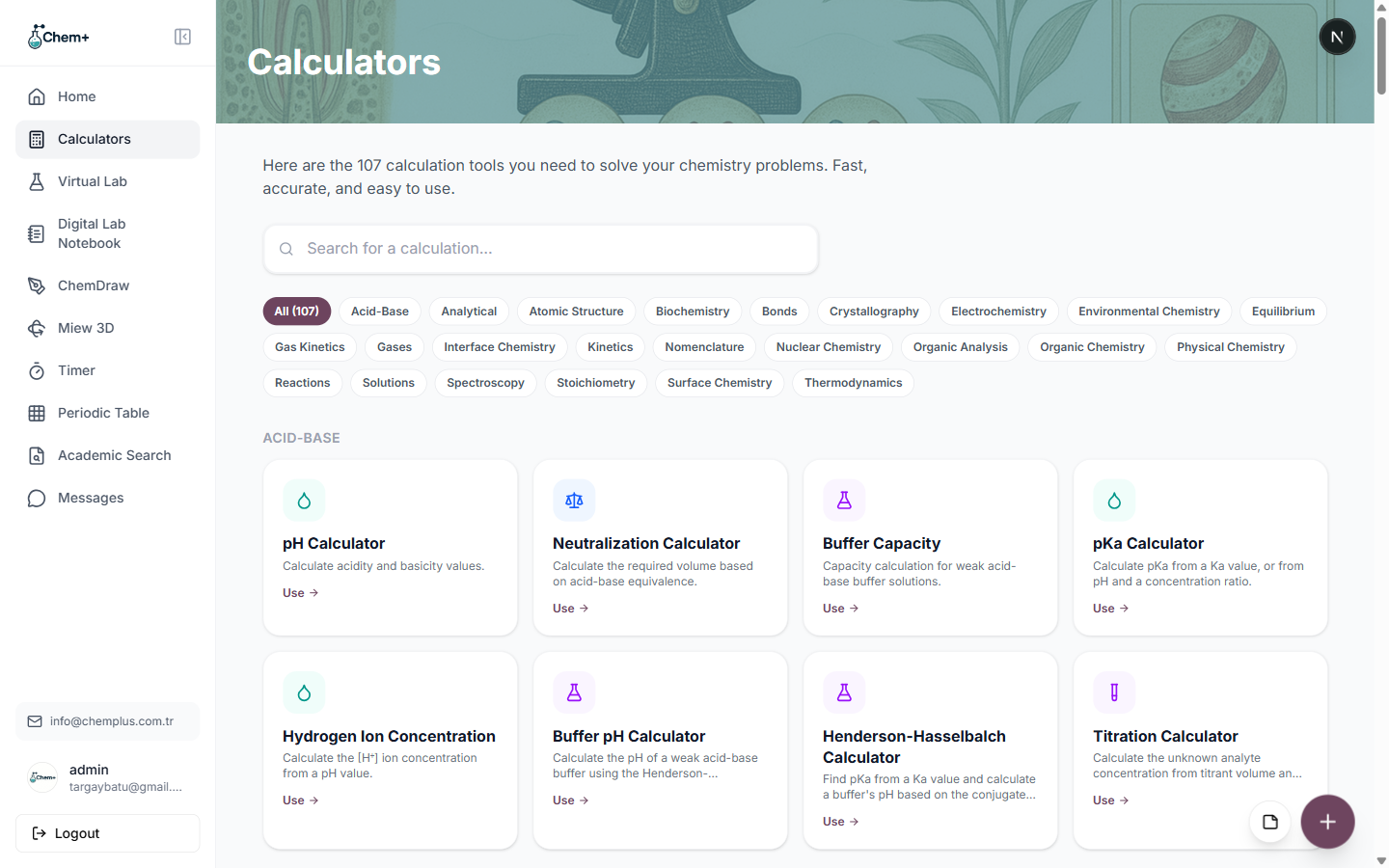
It's easy to say "107 chemistry calculators" and move on. It's harder — and much more useful — to answer the question a real chemist asks: what are they actually for? Not the formulas. The jobs. Because nobody opens a calculator for fun; they open it because there's a number standing between them and the next step. Here's what those numbers are.
For the student: getting unstuck on homework and pre-lab
The single biggest use of the calculator library is coursework. General and analytical chemistry are built on a handful of relationships you apply over and over, and the calculators cover them directly:
- Stoichiometry — molar mass, moles, limiting reagent, theoretical and percent yield, empirical and molecular formula. The workhorses of any intro course.
- Solutions — molarity, molality, dilution (the C1V1 = C2V2 you'll use a hundred times), and concentration conversions.
- Acid-base — pH, pOH, buffers, and titration helpers, plus a Henderson-Hasselbalch calculator for the buffer problems that trip everyone up.
The value here isn't doing the arithmetic for you — it's letting you check your work instantly and see how the answer moves when an input changes, which is how the concept actually sinks in.
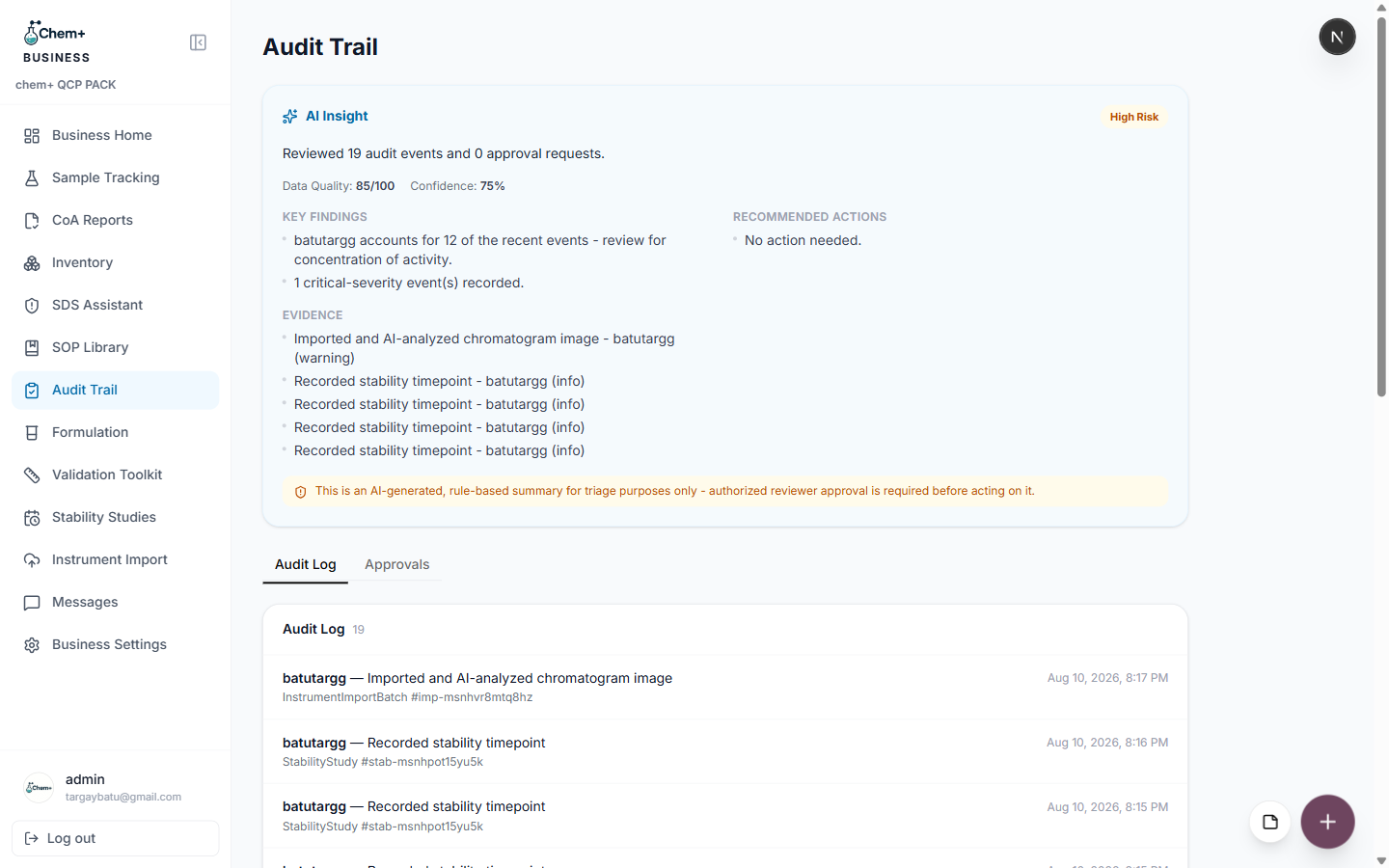
For the QC/analytical chemist: routine numbers, zero drift
In a quality or analytical setting, the same calculation runs day after day, and the risk isn't difficulty — it's a slow accumulation of small errors. The calculators remove that risk for the routine jobs:
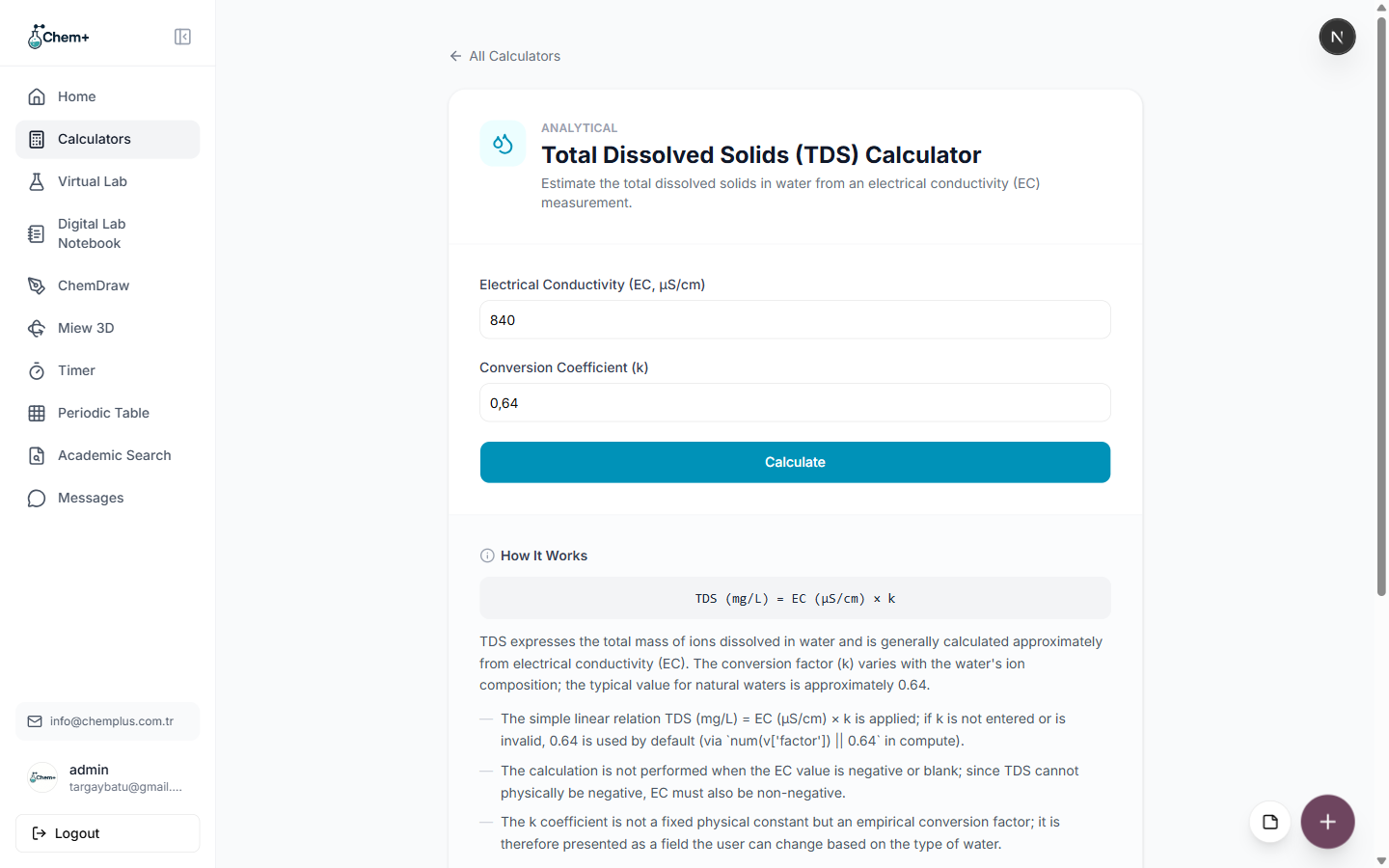
- Water and environmental analysis — the TDS calculator turns an electrical-conductivity reading into total dissolved solids using a conversion factor you can tune to your water type.
- Solution preparation — molarity and dilution calculators mean the reagent you make is the reagent your method specified, every time.
- Titration and equivalence — titration calculators back out an unknown analyte concentration from titrant volume, the bread and butter of wet-chemistry QC.
Because the formula is visible in every calculator's "How It Works" panel, you're never reporting a number you can't defend — which is exactly what an auditor will ask you to do.
For the researcher: the physical-chemistry backbone
Deeper into a project, the questions get more specialized, and the library goes with you:
- Gas laws — ideal gas, combined gas law, and partial pressures for anything involving gases.
- Thermodynamics — enthalpy and entropy calculations for reaction energetics.
- Equilibrium and electrochemistry — equilibrium constants and cell-potential tools for the quantitative core of physical chemistry.
- Specialized categories — crystallography, kinetics, spectroscopy, nuclear chemistry, and surface/interface chemistry, for when the work leaves the textbook behind.
The honest summary
The 107 calculators are for the moment a number is in your way — whether that's a homework problem at 11 p.m., a solution you're preparing for the third time this week, or a reaction energy you need before the next experiment. They don't replace understanding; they remove the friction between understanding and doing. And because they all live in one dashboard, next to your structures, your notebook, and your search, the answer never has to leave the room.