Which Analyses Rely on the Chem+ Calculators? From Water Testing to Titration
A calculator on its own is abstract. A calculator inside an analysis is a tool. So instead of listing the 107 by category, let's walk through the analytical workflows chemists actually run — and show where a calculator does the heavy lifting in each one. If you recognize your daily work in this list, you'll know exactly which tools to reach for.
Water quality analysis
Water testing is one of the most common routine analyses in labs, agriculture, aquaculture, and environmental monitoring — and it's calculator-heavy:
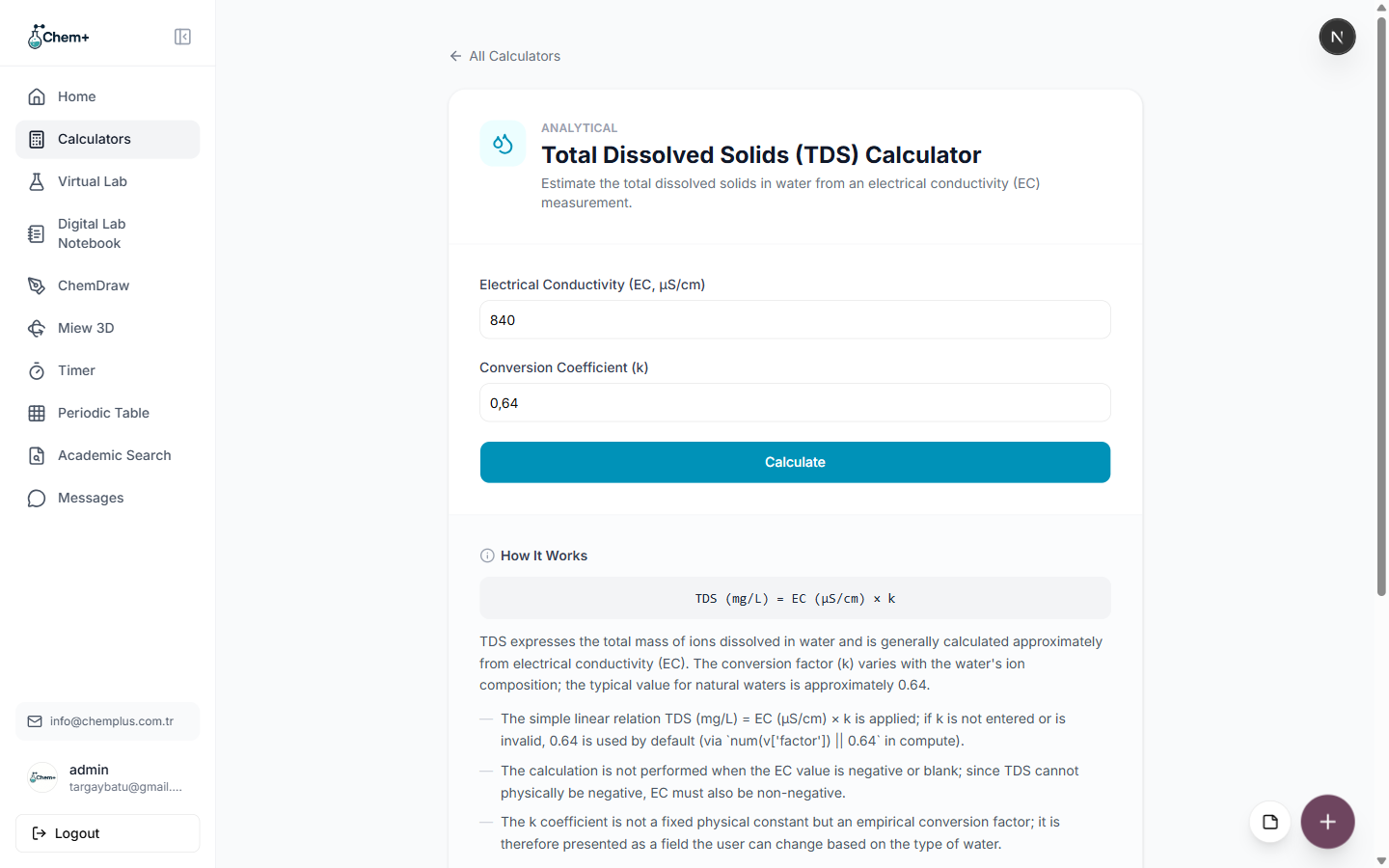
- Total Dissolved Solids from conductivity. The TDS calculator converts an electrical-conductivity (EC) reading into TDS in mg/L using TDS = EC × k, with a tunable k for your water's ion profile. It's the single most-used analytical calculator in the library.
- Related solution and concentration tools for expressing results in the units your report or regulation requires.
Solution and reagent preparation
Almost every wet-chemistry method starts with "prepare a solution of concentration X." Get that wrong and everything downstream is wrong:
- Molarity calculator to compute how much solute a target concentration and volume need — solving by mass or by moles.
- Dilution calculator (C1V1 = C2V2) for stepping a stock solution down to a working concentration without guesswork.
- Molality and concentration-conversion tools when a method specifies units other than molarity.
Acid-base and titration analysis
Titration is the classic quantitative analysis, and it's a whole cluster of calculators:
- pH and pOH for characterizing acidity before and after.
- Titration calculators to back out an unknown analyte concentration from the titrant volume at the equivalence point.
- Buffer and Henderson-Hasselbalch tools for preparing and understanding buffered systems.
Gas measurements and physical chemistry
When the analysis moves into the gas phase or into reaction energetics:
- Gas-law calculators (ideal gas, combined gas law, partial pressures) for volume, pressure, and temperature relationships.
- Thermodynamics tools for enthalpy and entropy when you're characterizing a reaction, not just running it.
- Equilibrium-constant and electrochemistry calculators for the quantitative core of a physical-chemistry study.
Specialized and instrumental analysis
For work that leaves the general-chemistry bench, the library still has a neighborhood:
- Spectroscopy, kinetics, crystallography, nuclear chemistry, and surface/interface chemistry categories, each with dedicated tools.
How to find yours
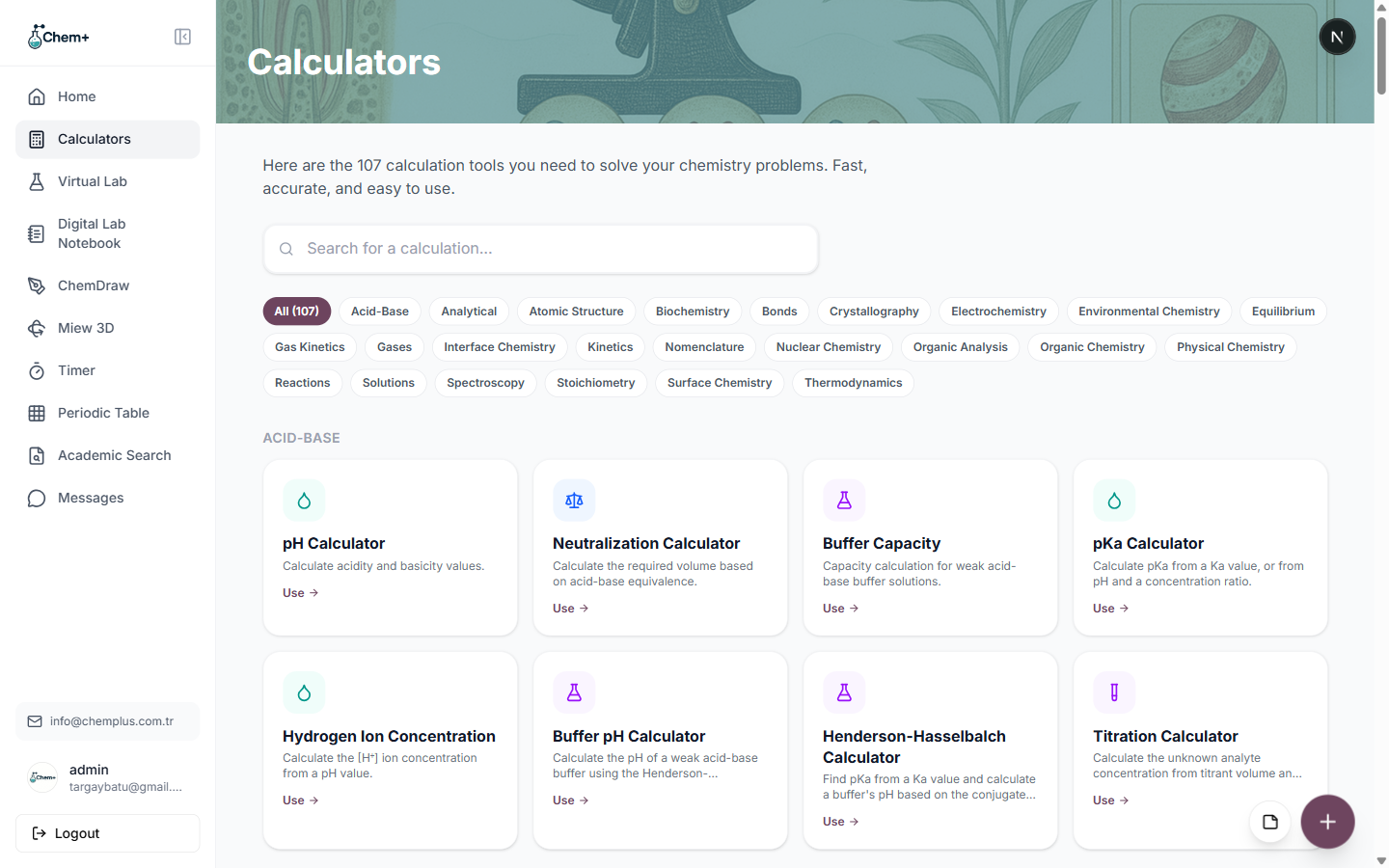
The fastest route from an analysis to its calculator is the category filter on the Calculators page — Acid-Base, Solutions, Analytical, Gases, Thermodynamics, and the rest map almost one-to-one onto the workflows above. Pick the category that matches your bench, and the tools you need are right there. And because every result can be copied, exported, or logged straight into the Digital Lab Notebook, the calculator isn't a detour from your analysis — it's a step inside it.